
Esophageal Regurgitation Under GA IS REAL!

It's happened to all of us - we're in the middle of a surgery and our technician tells us that the patient is regurgitating. While we continue to operate, our techs quickly clean out the mouth and double check to ensure the endotracheal cuff is snug. Now what? There are a variety of ways to address an obvious regurgitation including use of gastroprotectants (sulcrate, famotidine, omeprazole, etc.) as well as a post-operative lavage to attempt to neutralize the corrosive effects of the acidic material. In most cases, these patients recover well and do not develop severe esophagitis with complications. HOWEVER.......what if the regurgitation does unnoticed because it only made it into the distal esophagus and not all the way to the mouth? How common is this and how would we even know it happened? I'm here to tell you that subclinical esophageal regurgitation under general anesthetic does happen.....and probably more than you think.


Under normal conditions, the lower esophageal sphincter (LES) helps contain stomach material within the stomach and prevents it from entering the esophagus. The lining of the stomach is able to withstand the corrosive effects of stomach acid (and digestive enzymes) while it helps break up food, however the lining of the esophagus is more susceptible to damage from these same irritants. Under general anesthetic the LES can become relaxed, thereby allowing flow of stomach material back into the esophagus. In an awake patient this backflow might be quickly swallowed again and no long standing effects would be seen, however when this same patient is under a general anesthetic this regurgitated material sits in prolonged contact with the sensitive lining of the esophagus. Prolonged contact with stomach acid and digestive enzymes can cause damage ranging from minor inflammation and swelling, to deep ulceration of tissue and subsequent scarring. Not only is this painful for the patient, but can also occasionally lead to esophageal stricture (scarring down and narrowing of the esophagus). Esophageal stricture can obstruct the lumen of the esophagus making eating extremely difficult - a point highlighted by a difficult case I saw recently:


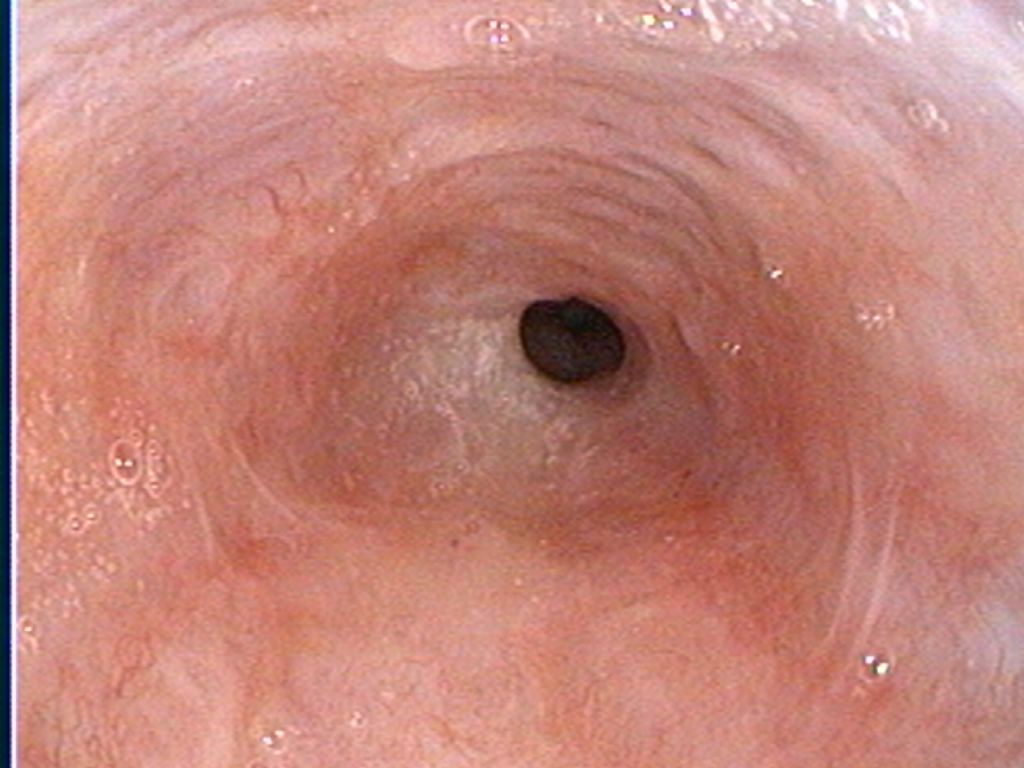
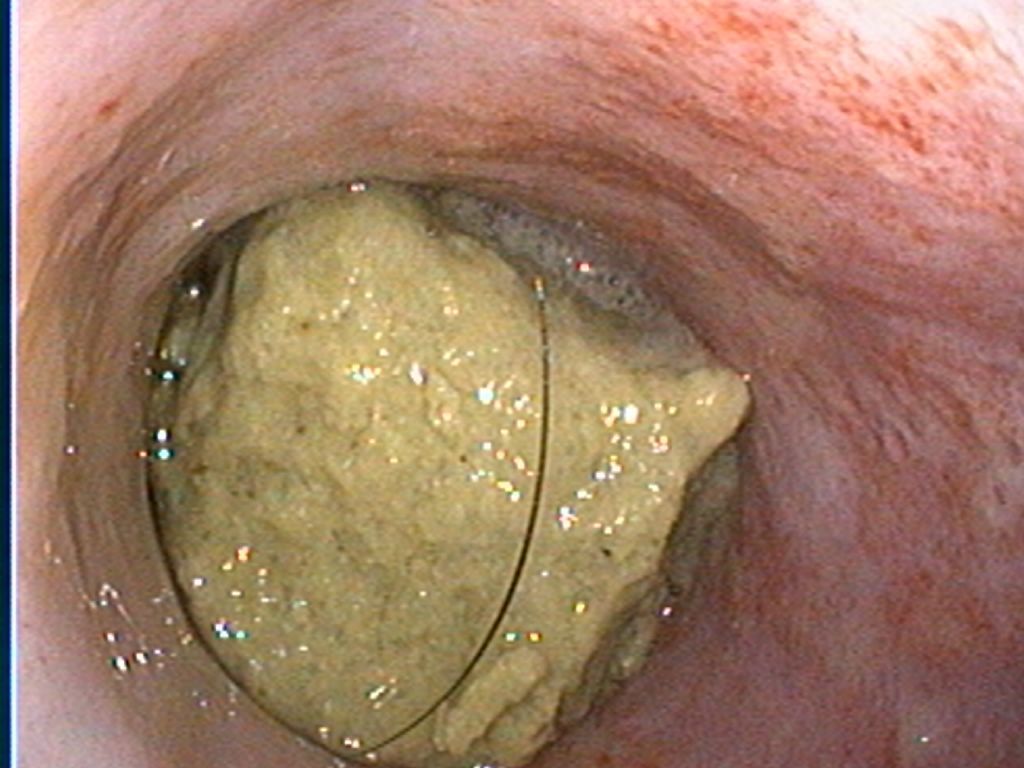
A 10 year old male neutered medium breed dog had undergone surgery approximately 2 weeks prior for a splenic mass. A splenectomy was performed and the dog seemed to recover without incident. Initially the dog was eating, albeit much more slowly and a smaller amount than usual - both of which were attributed to the serious surgery he had just undergone. As his recovery progressed the owner noted that he continued to eat very slowly and would vomit if he ate more than just a little bit of food at a time. After about 10 days it seemed to be worse and he would bring food back up shortly after eating (if not immediately after). The attending veterinarian became worried about a possible subclinical gastroesophageal regurgitation while under the previous general anesthetic and called me to perform an evaluation. I performed an esophagoscopy and immediately confirmed an esophageal stricture just anterior to the opening of the stomach (image 1). I was able to pass my scope through the stricture and evaluate the distal esophagus which showed marked ulceration and inflammation confirming a severe esophagitis (images 2 & 3). Gastroscopy was normal and as the scope was being retracted it was noted that the esophageal stricture had torn a small amount (presumably from the scope) making the lumen much more open.


The dog recovered from the anesthetic and was immediately put on medication for esophagitis. Balloon dilation was discussed as a possible treatment for the stricture, however the small tear had made the lumen larger and the owner and referring vet elected to treat the esophagitis and monitor for stricture recurrence (which is quite common). 10 days later the clinical signs had worsened so I repeated the esophagoscopy. Stricture recurrence was confirmed and this time I could not pass my scope through (image 4) although the level of esophagitis was greatly reduced. Referral for dilation was discussed again but the owner declined.


While cases like this unfortunately do happen, it's worth considering some measures that can be taken to try to prevent situations like this. At present, some veterinarians have considered using things like anti-emetics (metoclopramide, Cerenia) to try to keep lower esophageal sphincter tone tighter during GA. It is unclear how helpful this is, but it's worth considering due to the low risk of side effects in using medications like this. This may be especially true when performing a surgery that is longer or involving the digestive tract. Some surgeons will tip the table so that the head is slightly elevated, although this is not always feasible. Generally speaking, close observation in the 24 hours following surgery is essential as subtle signs of esophageal irritation may be picked up including: excessive lip licking, hypersalivation, dysphagia (difficulty swallowing), or painful swallowing. If any or these signs are noted, it is worth instituting treatment for presumed esophagitis - if started earlier, treatment may prevent damage from progressing to stricture. Most medications used in the treatment of esophagitis (gastroprotectants/Sulcrate, H2 receptor blockers +/- proton pump inhibitors) are well tolerated and safe and could be started sooner rather than later in suspect cases.

Recent Posts

Endoscopic view of a large, yellow gallstone lodged in a bile duct.
March 11, 2026
In their never ending quest to amaze pet owners and veterinarians, dogs (and sometimes cats) are always demonstrating how many things they consider "edible". While food products such as bones and corn cobs can be understood, less tempting items such as underpants, toys, stuffed animals, shoes and jewelry tend to make us scratch our heads. Most of these items will make their way down the esophagus into the stomach, and occasionally will pass through their digestive system without any major problems. However, quite often these items will become lodged somewhere and require treatment to be removed (eg: endoscopy to pull it out of the stomach or general surgery if further into the small intestine). On rare occasions a foreign object will become lodged in the esophagus and cause the pet great discomfort. Over the past while I have been asked to remove a few esophageal foreign bodies and these are never pleasant or easy to do. Objects that become lodged in the esophagus are typically larger and more firm in nature, making it harder for the pet to swallow down to the stomach. Once the object becomes stuck it can be difficult to dislodge and swift treatment is the best chance for preventing more serious secondary trauma. In particular, animals with esophageal foreign bodies are at a risk of pressure ulcerations forming in the esophagus (where the foreign material is tightly wedged). The esophagus is not able to distend like a stomach would and pressure sores (ulcers) can start to form fairly quickly. Should the foreign material be successfully removed, the esophagus begins to repair itself and scar tissue can form. If a large amount of scar tissue forms in an area there is a risk of stricture (shrinking down or narrowing of the opening in the esophagus). In extreme cases these strictures can cause the esophagus to become so narrow that food cannot get through. When this happens the process for opening that narrowed spot back up can be time consuming, uncomfortable for the pet, and expensive. In many cases, signs of an esophageal foreign body can be difficulty swallowing, repeated swallowing motions despite not currently eating anything, drooling, regurgitation when trying to eat, and even difficulty breathing if the object is putting pressure on the trachea (airway). BOTTOM LINE: If you think your pet has an object stuck in their throat, don't wait! The sooner you can get to a veterinarian to investigate the better. Case #1: 5 year old small breed dog that was eating a dental chew and swallowed a large piece that became lodged in the esophagus. She was not experiencing any respiratory issues and was stable, so the esophagoscopy was performed later that day. The foreign object was removed leaving a mild to moderate amount of inflammation to the tissue (seen as small red depressions on the lower left image. This little girl made a full recovery. Case #2: 10 year old small breed dog with history of regurgitation for a number of days prior to presentation to his veterinarian. Radiographs showed a large amount of foreign material in the esophagus and esophagoscopy was performed to attempt to remove the obstruction. During an extremely difficult procedure we removed multiple pieces of a small plastic toy combined with a large amount of hair. The esophagus was extremely ulcerated and we were concerned about a secondary stricture formation. Despite aggressive therapy a severe stricture did form and ultimately humane euthanasia was elected. While unfortunate, this serves to demonstrate the importance of recognizing a problem and treating it as quickly as possible.
Endoscopic view of a deep red organ, possibly the liver, with a silver surgical tool at the bottom.
March 11, 2026
At some point or another the chances are that your veterinarian has recommended running "wellness" bloodwork on your pet during a visit. While many people appreciate the benefit of wellness testing, there is still some confusion as to what it is and why we (as veterinarians) recommend it. Quite often, the question we'r
Endoscopic view of the colon interior, showing reddish, textured tissue and folds.
March 11, 2026
In my last post I discussed the options available when collecting intestinal biopsy samples. While both flexible endoscopic samples and laparoscopic assisted intestinal biopsy have their benefits, it really does come down to individual expectations and suspicion of disease(s). In this post, I thought I would summarize